
There’s only TWO Andy Burnhams: What brands can learn from both sides - The 87%

In London, the Prime Minister in waiting is something abstract, like a strategy. Outside it, he’s a fully formed, three-dimensional human who generates emotional responses from people.
It’s true that there are two Andy Burnhams in Britain right now and both are endlessly dissected as he prepares to lead the country. So it’s the perfect time to compare and contrast the divide between what London makes of the ‘King of the North’ and what the 87% of the population who don’t live in the capital have got to say.
Our 87% insights into the Burnham divide shows us how Britain now processes leadership, identity and trust. London analyses; the rest of the UK feels. And we reflect on what UK brands, often built in London, by London, for London — could learn and grow by increasing resonance.
How sentiment splits geographically
Using Pulsar for social listening, we recorded 15,653 mentions of Andy Burnham across X, Facebook, Instagram and TikTok from June 18th – 29th, and the results are fascinating.
The divide isn’t just stylistic. It goes to the heart of how politics is experienced in Britain. It is messy, emotional, impossible to ignore, and it’s baked into how people are talking about the MP for Makerfield.
London-based content
~60–65% neutral framing
~25–30% negative
~10–15% positive
Dominant tone: analytical, media-led, policy/strategy first
Outside London (North, Midlands, regions)
~40–45% positive
~30–35% negative
~20–25% neutral
Dominant tone: emotional, identity-driven, highly polarised
In London, online conversation clusters around neutral analysis. However, the regional discourse clusters around strong feeling (both for and against).
Repeatedly and throughout our dataset, Burnham appears as a question with a London audience. Will he challenge Starmer? What does this mean for Labour? How does this reshape the electoral map?
Even straightforward reporting from mainstream outlets frames him as a function of Westminster dynamics:
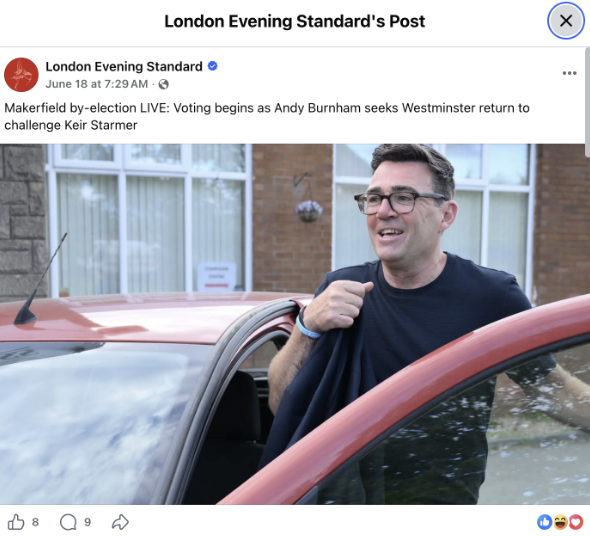
A policy risk:

Or even as part of an ideological equation:
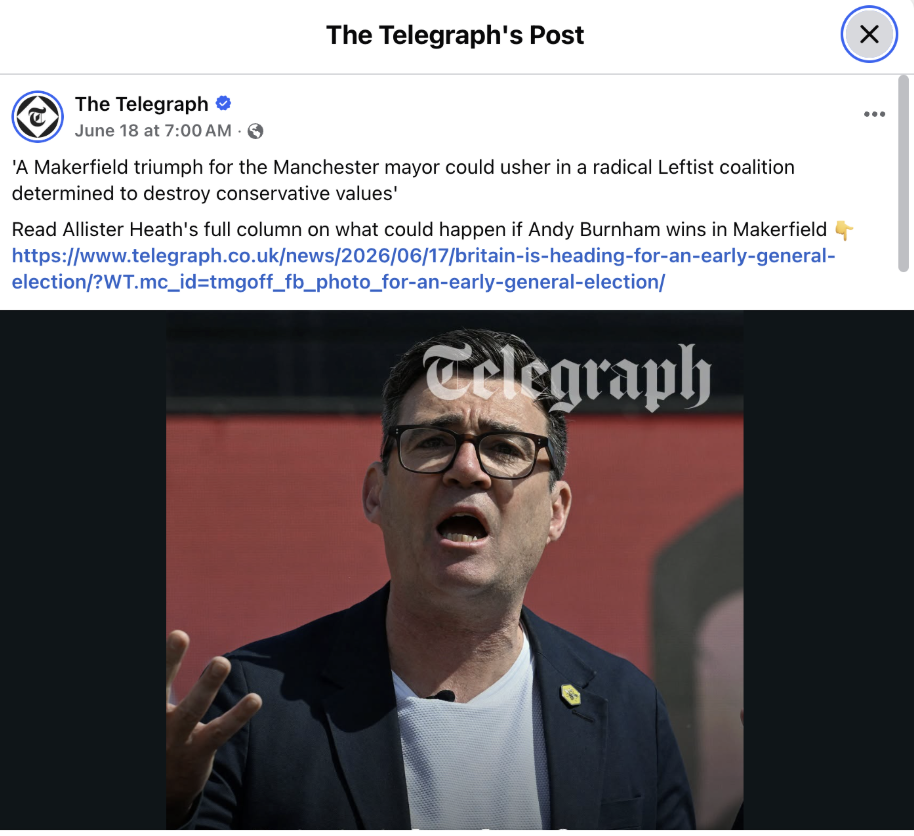
Zoom out and the pattern is clear. In London, they don’t know what to make of him or how it will impact them – only that he’s coming.
‘Outside the capital, the tone is very different. Campaign-driven posts by those close to Burnham use language such as ‘walking the streets’, ‘meeting constituents', ‘eye to eye’, ‘local’, ‘one of us’. Repeatedly, he is positioned as ‘Champion of the North’
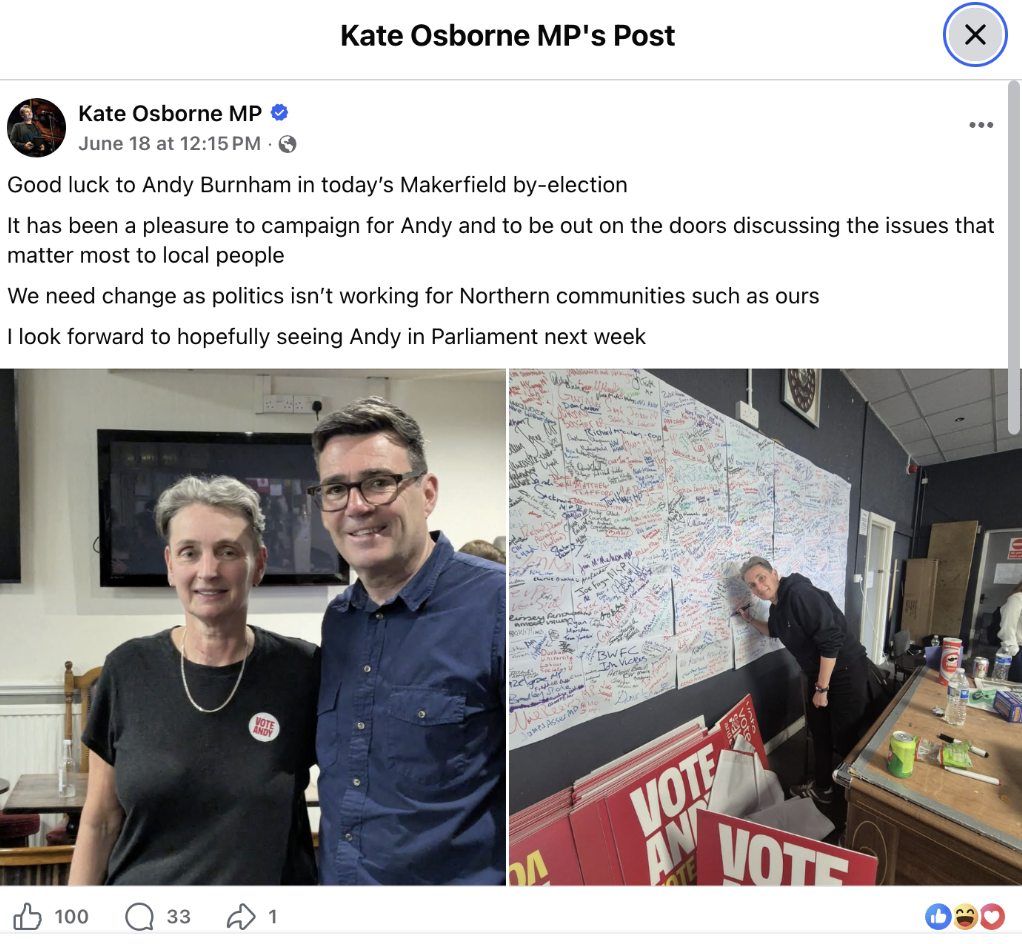
The volume of these posts drowns journalism. We recorded 3.4k posts from London but 12k from outside. In the north west in particular, this appears to have worked. Even beyond official campaign messaging, individuals describe him in strikingly personal terms as someone who ‘listens’, ‘connects with people’ and represents ‘working-class communities’.
Outside London, Burnham isn’t being evaluated. He’s being felt.
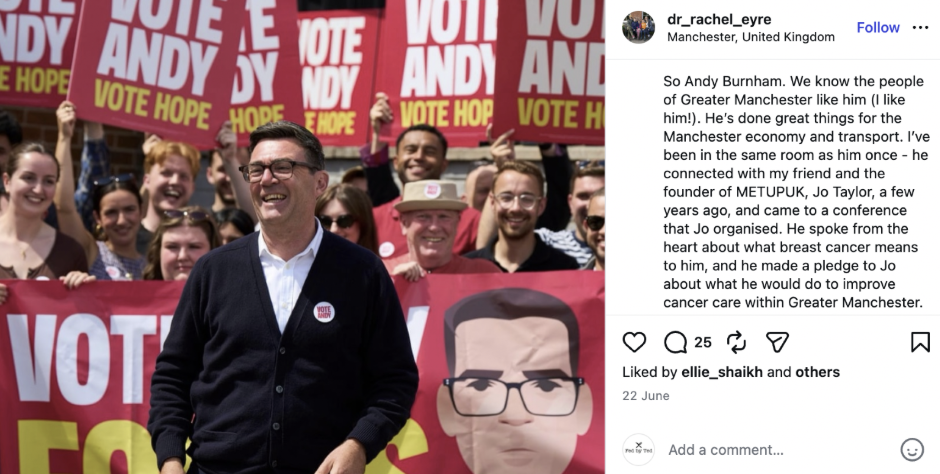
The authenticity divide
That emotional framing cuts both ways, because the most powerful attacks on Burnham outside London aren’t about policy, they’re about authenticity.
Is he who he says he is, or is it all about pursuing power?
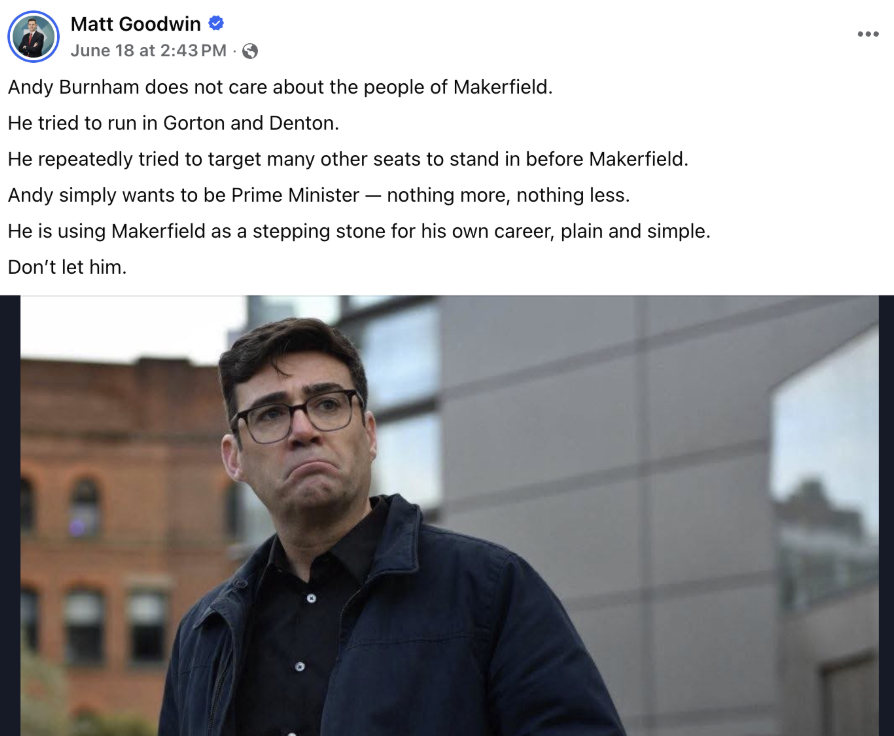
With some commentators, Burnham is a figure whose record raises deeper questions of trust:
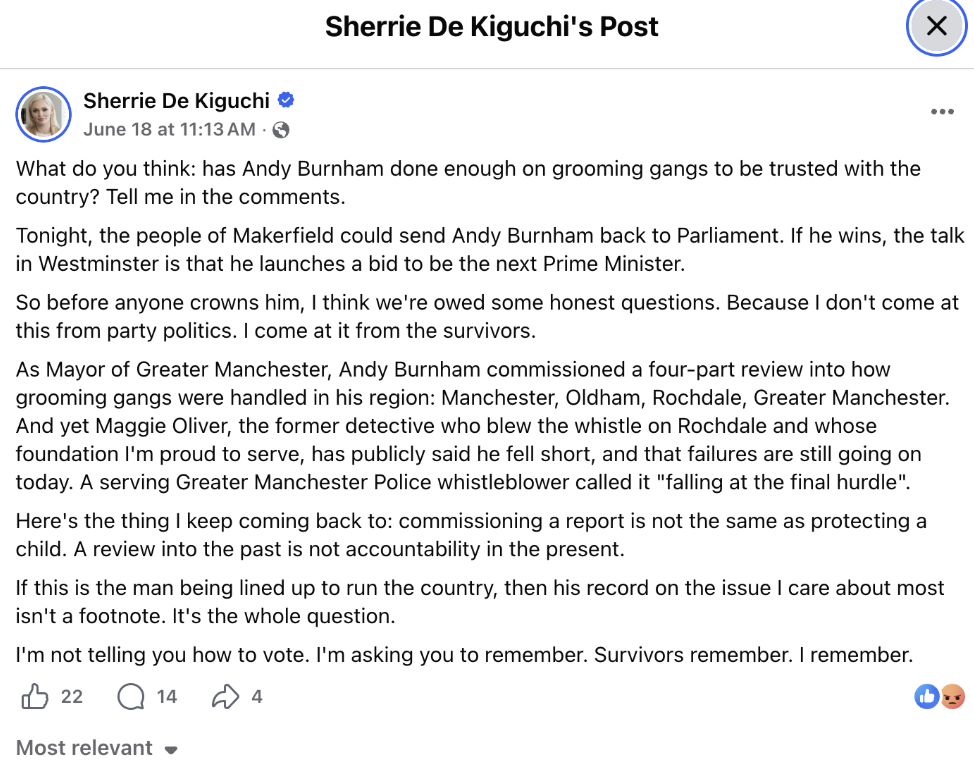
This is a fundamentally different test from London. As London asks️ ‘is this politically viable?’, the 87% appear to ask, ‘is this real?’
Emotional politics vs analytical politics
What emerges is a deep structural split in how politics is processed. London conversation is analytical, with a moderate amount of scepticism. Elsewhere, it is emotional, community-driven and highly polarised.
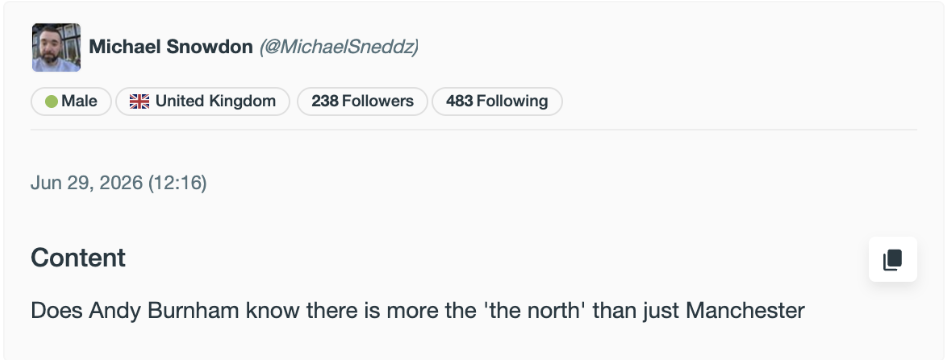
This post from Sunderland suggests Burnham could be wise to start distancing himself from Manchester already:
While in the south, the north-south divide rears its ugly head:
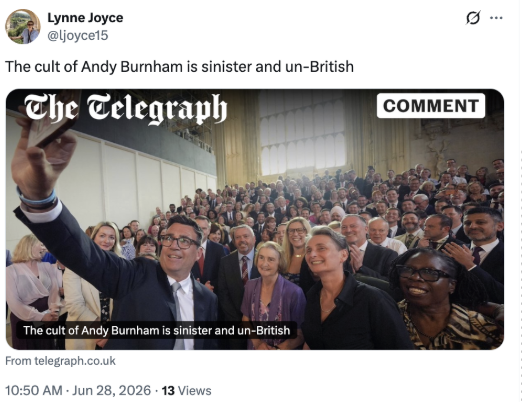
Supporters talk about hope, representation and pride while critics talk about betrayal, failure and distrust. The new Prime Minister’s biggest job will be to bring these two camps closer together as he tries to forge more national unity.
This isn’t really about Burnham though, it’s about how politics now operates in Britain. Who do we identify with most? Who gives off the best ‘vibes’? Only if a candidate gets past those two tests do people really want to know about policies.
Burnham just happens to sit on that fault line and his success in the biggest job in the country will hinge on how well he navigates across such tricky terrain. Whether you’re in London or not, people will be quick to voice their opinions.
If brands want national relevance, they need to cross the same fault line Burnham sits on: shifting from analytical communication to emotionally intelligent, community‑aware storytelling. The 87% aren’t just a bigger audience — they’re a more responsive one.
